
Regional Epidemiologist is the focal point of Epidemiology related activities.
OUR VISION
Healthy people in a healthy Sri Lanka.
OUR MISSION
To promote health and quality of life by preventing and controlling disease, injury and disability.
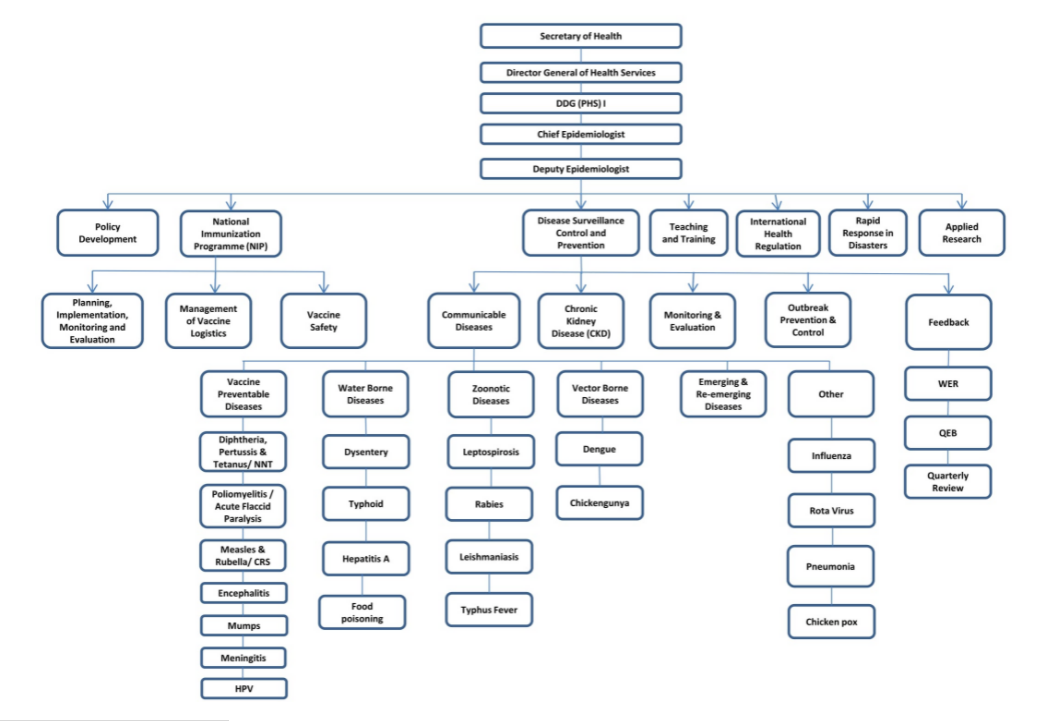
Functional Organogram
History of the Epidemiology Unit
These officers have had their epidemiological training with the support of the WHO.
The plan to appoint Regional Epidemiologists to all regional health divisions was hindered due to the scarcity of officers opting to remain in the field of public health. Those trained with the support of the WHO were appointed as Medical Officers of Health rather than Regional Epidemiologists. However, the next two regions covered by the services of Regional Epidemiologists were Jaffna and Vavuniya and thereafter, Kandy.
Colombo region was served by an assistant Epidemiologist from the Epidemiology Unit. Another assistant Epidemiologist from the Unit was assigned for non-communicable disease epidemiolgy. This officer was later appointed as the first director of the Cancer Control Programme after its establishment as a separate unit within the Ministry of Health.
A public health bacteriologist with postgraduate qualifications in bacteriology as well as in public health was appointed to the Unit in 1975. This officer was attached to the Infectious Diseases Hospital and the Lady Ridgeway Children’s Hospital in Colombo, but worked as a member of the Epidemiology Unit team and was involved in outbreak investigations and in special epidemiological studies. However, this post was suppressed following the retirement of this officer in the early eighties.
In early 1970s, the Unit was shifted to the building that now houses the Ministry of Health. By February 1986, the Epidemiology Unit was relocated at the present building at 231, De Saram Place, Colombo 10, which also houses the Family Health Bureau.
In 1995, the cadre allocated to the Unit was revised and the total number of Medical Officers was increased to 13. This number included two senior administrative grade officers and eight specialist grade officers. In addition to this, it was planned to appoint Regional Epidemiologists to all Districts and Provincial Epidemiologists to the Provinces. All 26 RDHS divisions are now served by a Regional Epidemiologist.
Over the years since 1959, the Unit has been steered by nine Chief Epidemiologists and at present, the Unit functions with a full cadre headed by the Chief Epidemiologist, Dr. Sudath Samaraweera.
EPI Programme:
EPI programme is one of the most successful public health interventions implemented by the Ministry of Health Sri Lanka. A number of partners contribute to the effectiveness of the current programme. They include the grass root level PHC workers, divisional, regional, provincial and national health managers and other workers. Regular monitoring has always been instrumental in optimizing the operational aspects of the programme since its inception. One of the main monitoring mechanisms, the annual “EPI and VPD Review” assesses the immunization coverage by PHM areas to verify the proportion of registered children who have been immunized according to the National Immunization Schedule. Some of the selected aspects of the quality of the EPI programme is also focused in the review.