
Environmental Health
Occupational Health
Food control
Environmental Health
What is Environmental Health ? It is the branch of public health that focuses on the interrelationships between people and their environment, promotes human health and well-being, and to develop healthy and safe communities. As a key component of a comprehensive public health system, environmental health works to advance policies and programs to minimize exposures in air, water, soil, food and other environmental media. It aims at to protect inhabitants and provide safe communities with healthier environments.
Our Role The Environmental health unit of the Ministry of Health, Nutrition and Indigenous Medicine is responsible for two major programmes under Environmental Health.
Our Role The Environmental health unit of the Ministry of Health, Nutrition and Indigenous Medicine is responsible for two major programmes under Environmental Health.
- National Healthcare waste management programme of the Ministry of Health, Nutrition and Indigenous Medicine.
- National Water Quality programme of the Ministry of Health, Nutrition and Indigenous Medicine.
- Solid waste management.
- Bio diversity.
- Climate change.
- Air pollution.
- Develop strategic plans to achieve the strategic objectives of the programmes under environmental health.
- Advocate the policy makers and stakeholders at central & provincial level on the importance of improving environmental health.
- Intra and inter sectoral coordination on multidisciplinary issues related to environmental health.
- Conduct operational research on environmental health issues.
- Capacity building of health and non health officers on environmental health.
- Provide technical expertise on environmental health in matters related to intra and inter sectoral planning, implementation, monitoring and evaluating of various programs/ activities at different levels.
- Monitoring and evaluation of programmes and activities under environmental health carried out by the Ministry of Health, Nutrition and Indigenous Medicine.
- Develop communication material pertaining to environmental health.
Occupational Health
Occupational Health is about workers’ health. A healthy workforce is the biggest asset a country can have and Sri Lanka is no exception. The National Occupational Health Programme targets all workers in all occupations. Occupational Health services are provided at the grass root level by Public Health Inspectors (PHII) together with the Medical Officers of Health (MOOH) through the District and Provincial Health systems.
Provision of occupational safety and health to workers in Sri Lanka needs a concerted effort of multiple stakeholders. The Ministry of Health is considered a very important stakeholder in the provision of occupational health services. Curative, rehabilitative, preventive and promotive occupational health services are provided by the Ministry of Health, Nutrition and Indigenous Medicine.
The Occupational Health Unit of the Environmental and Occupational Health Directorate is the focal point for Occupational Health in the Ministry of Health in Sri Lanka. The unit is responsible for planning, co-ordination, monitoring and evaluation of occupational health services in the National Occupational Health Programme. Additionally, the unit liaises with other important stakeholders such as the Ministry of Labour and Trade Union Relations, Ministry of Environment and Central Environmental Authority in implementing the National Occupational Health Programme of the Ministry of Health.
All workers in Sri Lanka have access to free health services at the curative, rehabilitative as well as preventive health sectors. Treatment of occupational diseases and injuries and rehabilitation of occupational injuries are integrated into the existing curative health system. Occupational medical problems are taken care of by the medical units, occupational surgical problems by the surgical units and rehabilitation by the physiotherapy and rehabilitation units. Occupational accidents affecting significant number of workers and surrounding communities are considered as disasters and curative sector response is carried out immediately.
The implementation of occupational health activities in the preventive health sector are done mainly through the Provincial and District level Health Services which comprise of a wide range of MOH offices. The Medical Officers of Health (MOOH) and the Public Health Inspectors (PHII) carry out occupational health activities at the grass root level. Environmental and occupational health units have been set up at district level to better facilitate the implementation of the National Occupational Health Programme and to strengthen the coordination between the Directorate of the Environmental and Occupational Health and the grass root level.
Functions of the Unit
Provision of occupational safety and health to workers in Sri Lanka needs a concerted effort of multiple stakeholders. The Ministry of Health is considered a very important stakeholder in the provision of occupational health services. Curative, rehabilitative, preventive and promotive occupational health services are provided by the Ministry of Health, Nutrition and Indigenous Medicine.
The Occupational Health Unit of the Environmental and Occupational Health Directorate is the focal point for Occupational Health in the Ministry of Health in Sri Lanka. The unit is responsible for planning, co-ordination, monitoring and evaluation of occupational health services in the National Occupational Health Programme. Additionally, the unit liaises with other important stakeholders such as the Ministry of Labour and Trade Union Relations, Ministry of Environment and Central Environmental Authority in implementing the National Occupational Health Programme of the Ministry of Health.
All workers in Sri Lanka have access to free health services at the curative, rehabilitative as well as preventive health sectors. Treatment of occupational diseases and injuries and rehabilitation of occupational injuries are integrated into the existing curative health system. Occupational medical problems are taken care of by the medical units, occupational surgical problems by the surgical units and rehabilitation by the physiotherapy and rehabilitation units. Occupational accidents affecting significant number of workers and surrounding communities are considered as disasters and curative sector response is carried out immediately.
The implementation of occupational health activities in the preventive health sector are done mainly through the Provincial and District level Health Services which comprise of a wide range of MOH offices. The Medical Officers of Health (MOOH) and the Public Health Inspectors (PHII) carry out occupational health activities at the grass root level. Environmental and occupational health units have been set up at district level to better facilitate the implementation of the National Occupational Health Programme and to strengthen the coordination between the Directorate of the Environmental and Occupational Health and the grass root level.
Functions of the Unit
- Advocacy on issues related to occupational health and related environmental health issues.
- Provision of guidance and technical expertise to the Ministry of Health, Ministry of Labour, Ministry of Environment, Central Environmental Authority and other relevant ministries for formulation/revision of policies, on occupational health and related environmental health aspects.
- Develop policies and strategies on occupational health.
- Designing / Planning of National Occupational Health Programme of the Ministry of Health.
- Liaise with intra sectoral and inter sectoral stakeholders in designing the occupational health programme.
- Provision of necessary direction, guidance, coordination and support to peripheral staff for implementation of the National Occupational Health Programme of the Ministry of Health.
- Develop guidelines, standards and protocols on occupational health.
- Capacity building of staff on occupational health, basic training, in service, graduate and post graduate.
- Networking and partnership building with stake holders and programme implementers.
- Developing programme specific education and training material/IEC.
- Provision of technical expertise to develop and revise curricula of basic and in service training of relevant health staff on occupational health.
- Implementing donor funded projects on occupational health.
- Monitoring and Evaluation of Occupational Health Services at all levels.
- Conducting and coordinating operational research related to occupational health.
- Identification of best practices, pilot testing and integration into the occupational health programme.
- Procurement and distribution of equipments necessary for the occupational health programme.
- Convene national steering committee on occupational health (chaired by Secretary / DDG).
Food control
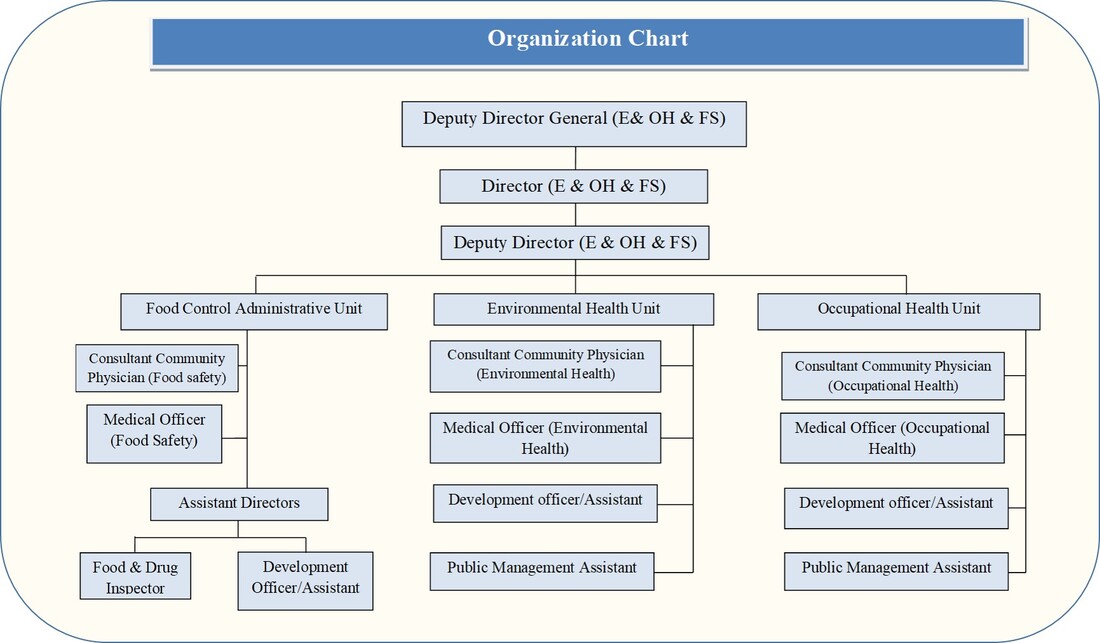
Food control in the country is a subject under the Ministry of Health. Food Act No.26 of 1980 is the legal basis for action.
Director General of Health services is the chief food authority. Deputy Director General (Environmental health, occupational Health and food safety) functions under the DGHS as the head of food control. Director (EOH) functions under the DDG and handles all routine activities in the Food control Administration Unit (FCAU).
FCAU is responsible for import control, domestic control of food and issuing export certificates for exporting food items.
Domestic food control system in Sri Lanka is based on the Food Act No.26 of 1980 which was amended in 1991 and 2001. According to the food Act, Chief food authority is the Director General of Health Services.
Other food authorities are,
What the Food Labs Do ?Food-borne diseases remain a challenging problem globally, causing many diseases and significant economic losses. Contaminants in food can cause acute or chronic diseases. Those contaminants can be,
Foods that are imported, exported and those available in the market are tested for various parameters. Therefore these laboratories help the Food control administration unit of the Ministry of Health to ensure that the food available in the country are safe to consume. Laboratories can be divided into 2 groups.
Director General of Health services is the chief food authority. Deputy Director General (Environmental health, occupational Health and food safety) functions under the DGHS as the head of food control. Director (EOH) functions under the DDG and handles all routine activities in the Food control Administration Unit (FCAU).
FCAU is responsible for import control, domestic control of food and issuing export certificates for exporting food items.
Domestic food control system in Sri Lanka is based on the Food Act No.26 of 1980 which was amended in 1991 and 2001. According to the food Act, Chief food authority is the Director General of Health Services.
Other food authorities are,
- Municipal councils.
- Appointed local authorities by the Minister.
- Medical Officer of Health (If local authority is not appointed by the Minister in that area).
- Excise commissioner.
- DG of customs.
- Medical officer of health.
- Food and drug inspector.
- Public health inspector.
- Veterinary surgeon with regards to meat.
What the Food Labs Do ?Food-borne diseases remain a challenging problem globally, causing many diseases and significant economic losses. Contaminants in food can cause acute or chronic diseases. Those contaminants can be,
- Physical (Adulterants, Additives etc.)
- Chemical (Heavy metals, Toxins etc.)
- Microbiological (Bacteria, Virus etc.)
Foods that are imported, exported and those available in the market are tested for various parameters. Therefore these laboratories help the Food control administration unit of the Ministry of Health to ensure that the food available in the country are safe to consume. Laboratories can be divided into 2 groups.
- Authorized laboratories under the food Act. (These laboratories test formal samples)
- Non-authorized laboratories (These laboratories test informal samples Eg. Imported foods)